How Cloud Cover Changes the Colours You See Through a Window
Cloud cover changes the colours you see through a window. Learn to separate shifts in colour, brightness and contrast with a simple, useful observation.
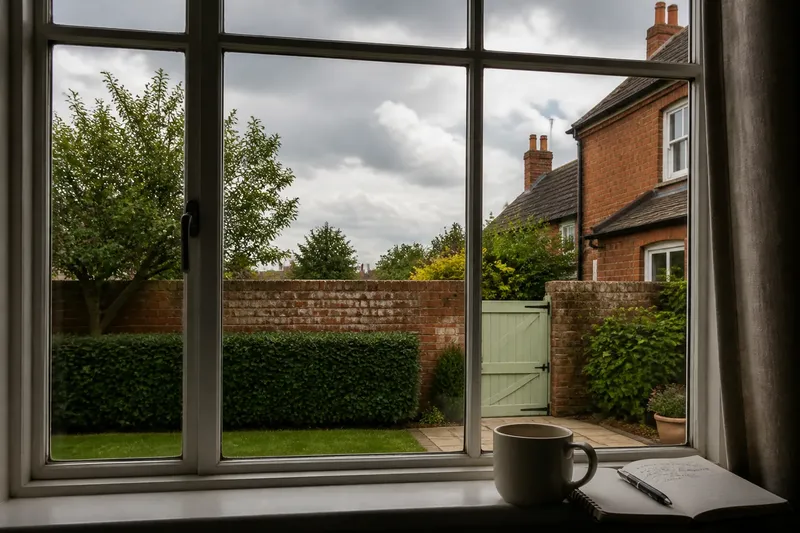
Cloud cover changes the colours you see through a window by changing the light on the scene, not the colour of the objects themselves. Compare one view in different light and describe colour, brightness and contrast separately; that distinction makes your observations clearer.
Choose visible surfaces
Look for a view with several easy-to-find surfaces: red brick, green leaves, pale paving or a painted gate. Include both a dark object and a light one, plus a clear boundary such as a fence against a wall. These give you different features to observe without needing to identify exact shades.
You do not need to hold your body rigidly in one spot. Instead, keep the same objects in view and note any change in your position or surroundings that could affect what you see. A reflection from a lamp, a curtain moving across the window or a sunlit patch shifting behind a building can complicate the comparison.
Separate three observations
Cloud cover often changes the amount and direction of light reaching outdoor surfaces. Describe three things independently:
- Colour: Does the surface seem warmer, cooler, more vivid or more muted?
- Brightness: Does the whole scene or a particular surface look brighter or dimmer?
- Contrast: Is the edge between two surfaces easy to distinguish, and can you still see detail within each one?
A dark tree can remain distinct against a bright sky while its leaves merge into a less detailed mass. That is a change in detail and contrast within the tree, even if its outline remains clear. Naming the specific feature avoids the vague claim that the whole view has simply “changed”.
Use a short observation record
Write down three or four reference objects and a few plain words about each. Add a brief description of the sky, such as “bright gaps between thin cloud” or “even grey cover”. Avoid trying to match a precise colour name: “muted green” is a more useful note than a guess at an exact shade.
When the light visibly shifts, add another set of notes. Record what changed and what did not. If a reflection appears or a lamp comes on, mention it too; that gives you a reason to treat the comparison cautiously rather than attributing every difference to clouds.
- If the same surfaces remain visible and the sky brightens, compare their colour and brightness; if a new reflection appears, note it before drawing a comparison.
- If a boundary between two objects becomes harder to pick out, check whether the overall light has softened; if the boundary stays clear, record that rather than assuming all contrast has fallen.
- If a surface looks less vivid, describe the perceived shift; if its appearance seems unchanged, write that down instead of forcing a difference.
- If details within a dark object blur together, distinguish that from its outline; if both remain clear, record the two observations separately.
- If a nearby lamp adds colour to the glass, switch it off when practical; if that is not possible, mark the reflection as a limitation.
- If the sky remains uniformly grey and the view looks steady, stop the comparison there; if conditions change later, make a fresh note rather than inventing a shift.
Read the light carefully
Under direct sunlight, a surface may have a bright side and a deeper shadow. When cloud spreads over it, those strong divisions may soften. The effect varies across a scene: pale paving can still stand apart from a dark tree, while small differences between neighbouring leaves become harder to see.
Your eyes also adjust as the scene becomes brighter or dimmer. For that reason, focus on descriptions such as “the fence edge is less distinct” rather than treating a remembered shade as an exact reference. The purpose is to describe the view, not to claim that you have measured its colour.
What changes in cloudy light?
Does cloud cover change an object’s colour?
No; the object itself need not change for its appearance to shift. Light falling on it and the surrounding scene affects how its colour seems to you.
Why can colours look muted?
Cloud can soften the light and reduce the strong differences between lit and shaded areas. A colour may then seem less vivid, though the effect depends on the surface and what surrounds it.
Are phone photographs reliable records?
They can help you remember which objects were in view, but a phone may adjust exposure, colour and contrast automatically. Use the image as supporting context, not as a precise account of what your eyes perceived.
What if nothing appears to change?
Record that the scene looked steady. If the cloud cover and view remain similar, there may be no meaningful comparison to make; wait for another change in light rather than inventing one.
A worked garden comparison
Say you can see a red brick wall, a dark hedge and a pale garden gate from your kitchen. At the start, thin cloud leaves bright patches on the wall; you note “brick warm”, “hedge outline clear” and “gate edge distinct”. Later, thicker cloud covers the view, and you write “brick looks duller”, “hedge outline still clear, leaves less distinct” and “gate edge still distinct”. The result is a specific comparison: the perceived brick colour and detail within the hedge shifted, while the gate boundary and hedge outline remained easy to see.
Skip false precision
It is not worth using a paint chart or colour-identifying app to assign exact names to small patches. The display, camera and changing view can all influence the result, while exact labels distract from the more useful distinction between colour, brightness and contrast. Plain, consistent descriptions are enough.
For a useful account of how cloud cover changes the colours you see through a window, name the surfaces, describe the light and separate each visible change from what stayed steady. That approach gives you a clear record without mistaking a shift in appearance for a change in the objects themselves.