Plane and Curved Mirrors: How Their Reflections Differ
Plane and curved mirrors shape reflected light differently. Learn how surface shape affects image size, orientation and field of view, and how to read each reflection.
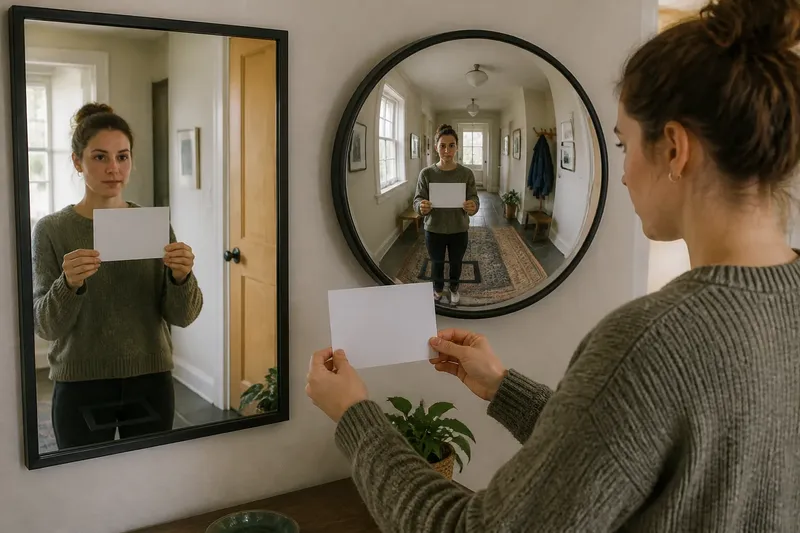
A plane mirror preserves familiar proportions; a curved mirror can make the same doorway look wider, smaller or even upside down. Comparing plane and curved mirrors is easiest when you focus on the paths light takes from an object to your eyes.
One rule, different surfaces
Light from a sleeve or door frame travels in many directions. Some rays reach a mirror and reflect towards your eyes. At each point, the angle of reflection matches the angle of incidence, measured from a line perpendicular to the surface.
That perpendicular is called the normal. On a plane mirror, its direction stays constant across the face. On a curved mirror, the normal changes from point to point, so neighbouring patches send reflected rays in different directions.
Plane mirror images
A plane mirror reflects rays without systematically bringing them together or spreading them apart. Your eyes trace the rays backwards, so the image appears behind the surface even though light does not meet there. This is a virtual image.
The apparent image is as far behind the mirror as the object is in front. It keeps the object’s apparent size and shape, though distance from your eyes still affects how large it looks compared with something nearby.
The familiar left-right reversal is more precisely a reversal in the direction perpendicular to the mirror. The mirror does not exchange top and bottom; your viewpoint and interpretation make the reflection seem to swap sides.
Convex mirror views
A convex mirror bulges towards the viewer. Its surface normals point in different directions, sending reflected rays apart. Tracing those rays backwards places a smaller virtual image behind the mirror.
Because the scene takes up less apparent space, more of the surroundings can fit into the reflection. A convex mirror can therefore show a wider view, but objects may seem smaller and farther away than they are.
Concave mirror changes
A concave mirror curves inward. It can direct reflected rays towards one another, and the image depends on the object’s position relative to the mirror’s focal region.
With an object close to a concave mirror, the image can appear upright and enlarged. At a different distance, reflected rays can cross, producing an inverted image. The mirror’s curvature and the object’s position both matter; the word “concave” alone does not tell you the image’s orientation.
What should you look for?
Use an object with a clear outline, such as a rectangular card or a door frame. Keep your viewing position steady, then compare the reflection in the centre and near the edge. These observations help distinguish curvature from dirt or surface damage.
- Observe the surface profile: If it is flat, treat it as a plane mirror; if it bulges towards you, treat it as convex; if it curves inward, treat it as concave. If the profile is unclear, avoid inferring the mirror type from one image alone and inspect its edge or maker’s description.
- Observe a straight edge: If it stays straight across the reflection, note that distortion is not obvious; if it bends, compare the centre and edges to see whether the effect follows the mirror’s curve.
- Observe apparent size: Keep the object and your position fixed; if it looks smaller in one mirror, decide whether that surface is convex or the object is simply farther away, then hold the distance constant to distinguish the two.
- Observe image orientation: If a concave mirror shows an upright image, keep the object near its surface; if the image is inverted, move the object only if you can do so safely and note that its position has changed the ray pattern.
- Observe the field of view: If a convex mirror includes more of the surroundings, use it when broad coverage matters; if accurate apparent size matters more, choose a plane mirror instead.
- Observe the clarity of the reflection: If a smeared patch obscures detail, clean it gently with a soft cloth; if waviness remains on a clean surface, consider unevenness rather than assuming the mirror is curved.
It is not worth measuring reflection angles or trying to calculate a focal length for a casual comparison. A steady viewing position and a recognisable straight edge are enough to reveal the main differences.
Choosing a mirror
Choose a plane mirror for a familiar view with preserved proportions. A convex mirror suits situations where seeing more of the surroundings matters more than judging apparent size. A concave mirror can give an enlarged close view, but its image changes with object position.
Say you are choosing between a flat mirror and an outward-bulging panel for a hallway. You hold the same rectangular card at the same spot and look from a marked place on the floor. In the flat mirror, the card keeps its shape and familiar proportions; in the convex panel, it appears smaller and more of the hallway enters the view. If your priority is checking the card’s shape, choose the flat mirror; if it is seeing more of the hallway, choose the convex one.
Questions about mirror images?
Why does a plane mirror keep the image’s size?
Its surface orientation is consistent, so it does not systematically spread or converge reflected rays. An object can still look smaller if it is farther from your eyes.
Why does a convex mirror show more?
Its outward curve directs rays from a broader range of directions towards the viewer. The wider view comes with a smaller-looking image.
When does a concave mirror invert an image?
An inverted image can form when reflected rays cross before reaching your eyes. The object’s position relative to the mirror’s focal region determines whether the image is upright or inverted.
Can curvature bend a reflected line?
Yes. Different parts of a curved surface redirect light at different angles, so a straight object can look warped. Dirt or an uneven surface can also disturb the view, but these are separate causes.
Reading the reflected scene
When a reflection seems surprising, separate three questions: what is the mirror’s surface shape, how has it changed the rays, and where is the object relative to the mirror? For plane and curved mirrors, those details explain apparent size, orientation and field of view without treating the reflection as a literal copy of the room.