Why a White Surface Can Look Blue in the Shade
Why a white surface can look blue in the shade: see how cooler skylight changes its appearance and how to separate light colour from surface colour.
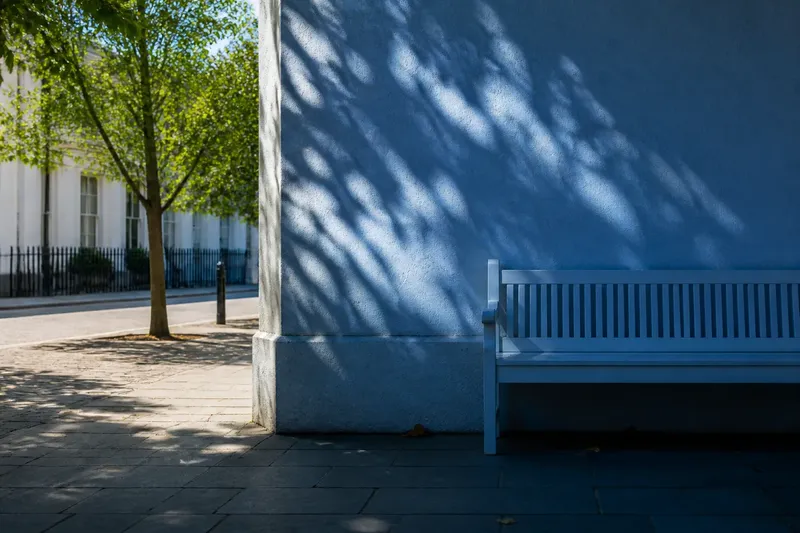
A white surface can look blue in the shade because the light reaching it is often bluer than direct sunlight. The surface still reflects light much as before; the change is in the light available to reflect. This is why a white wall, sheet of paper or parked car can take on a cool cast beneath a tree or beside a building.
White depends on its light
We often treat white as a fixed property, like the shape of an object. But the colour we see depends on light arriving at the object and then reaching our eyes. A white surface reflects a broad range of visible light rather than strongly favouring one narrow band. Change the light, and the mixture reflected towards you changes too.
In direct sun, a white object receives sunlight that has travelled through the atmosphere to the ground. In open shade, the sun is blocked, but the object is not left in darkness. It is lit by light scattered across the sky, along with light reflected from nearby surfaces. The balance of these sources differs from the balance in direct sun.
For a simple comparison, hold a white card so one part catches sunlight and another part sits in the shadow of a nearby object. The sunlit part may look warm or neutral, while the shaded part appears cooler. The card has not changed; its illumination has.
Why shade turns cool
Sunlight reaching the ground directly contains a broad mix of colours. Some of that light is scattered by air molecules and fine particles in the atmosphere. Shorter blue wavelengths scatter more readily than longer red wavelengths, so the open sky sends blue-rich light towards shaded places.
A roof, wall or tree can block the direct beam while leaving the shaded surface exposed to a large area of sky. That skylight becomes a prominent source. It is usually weaker than direct sun, but its relative colour matters: with the warm direct light removed, the cooler sky illumination is easier to notice.
Shade is not always blue. Under a leafy canopy, reflected green light may tint a white object. Near a red brick wall, bounced light can add a warm cast. A shaded spot under a deep overhang may receive little open-sky light and instead reflect the colours of its surroundings. The observed colour depends on what can illuminate the surface, not simply on the label “shade”.
Surface and illumination
It helps to separate two questions: what light reaches the surface, and what the surface reflects. A white object reflects much of the light falling on it. A blue-painted object reflects a more selective part of that light and absorbs more of the rest. Both can look different when the illumination changes, but the painted surface has its own colour-selective behaviour.
This distinction also explains why a white object in blue shade does not necessarily become a blue object. Move it into sunlight and its appearance can shift back towards white or warm neutral. The change follows the lighting conditions. A permanently blue mark, by contrast, remains associated with the material even as its brightness and cast change.
Say you are choosing white fabric for an outdoor display. A sample looks clean and neutral on a sunny table, but appears icy beneath a north-facing porch. If you compare it in both places, you can see that the porch’s sky light alters the sample’s appearance; the fabric itself has not acquired a new dye colour. That distinction can help you judge the material in the setting where it will be seen.
Why our eyes adjust
Your visual system does not report every lighting change as a new surface colour. It partly adapts to the general illumination, helping familiar objects remain recognisable under different light. This is often called colour constancy. It is useful, but it is not perfect: a large patch of blue shade, a small viewing area or a sudden change from sun to shadow can make the cool cast stand out.
Surroundings also influence the judgement. A white object beside warm-coloured brick may seem especially blue by comparison, even if the light on it has not changed. Against a blue sky, the same shaded surface may seem less obviously blue. The eye interprets colour in context, so nearby colours can strengthen or soften the impression.
For a practical check, compare two matching white surfaces at the same time, one in sunlight and one in open shade. Then bring both under the same light, if convenient. If their apparent difference largely disappears under shared illumination, the original contrast came mainly from the light, not from a difference in the objects.
Reading colour in shade?
Is the object actually blue?
Not necessarily. If the cool tint changes when the object moves between sunlight and shade, illumination is a strong part of the explanation. A lasting colour difference between matching surfaces under the same light points more towards their materials or finishes.
Does every shade look blue?
No. Open shade often receives blue-rich skylight, but nearby leaves, walls, paving and roofs can add other colours. A shaded surface can therefore look greenish, warm or nearly neutral.
Why does a photograph look bluer?
A camera records the light reaching its sensor, and its automatic colour adjustment may not match the way your eyes adapted to the scene. The result can preserve a cool cast that seemed less striking in person, or shift the scene in another direction.
Can a white object look grey in shade?
Yes. Shade usually provides less light than direct sun, so the surface may look darker as well as cooler. Brightness and colour cast are related to the illumination, but they are not the same visual change.
What is worth checking
When a white surface looks unexpectedly blue outdoors, look first at the light path. Is direct sun blocked? Can the surface see a broad patch of sky? Is there a strongly coloured wall, canopy or paving nearby? These observations often explain the cast without requiring a change in the object.
For judging paint, fabric or paper, inspect a sample under the light in which it will actually be used. A small swatch held against a large white surface can be misleading if one is in sun and the other in shade. Compare like with like: same place, same light, and a neutral background if one is available.
It is not worth chasing a perfectly neutral white in every outdoor setting. Natural light shifts across a scene, and a surface can look different as clouds move or the sun passes behind an obstruction. The useful question is whether the colour suits the setting and remains acceptable through the lighting conditions that matter to you.
So, why a white surface can look blue in the shade comes down to a change in illumination: direct sunlight is blocked, and cooler skylight or coloured reflected light takes its place. When you notice the cast, compare the surface under shared light before deciding that its material has changed. That simple distinction makes outdoor colour easier to read.