Why a Shadow Edge Turns Soft
Understand shadow-edge softness by reading the source and object positions, then choose a simple setup that makes the boundary easier to see.
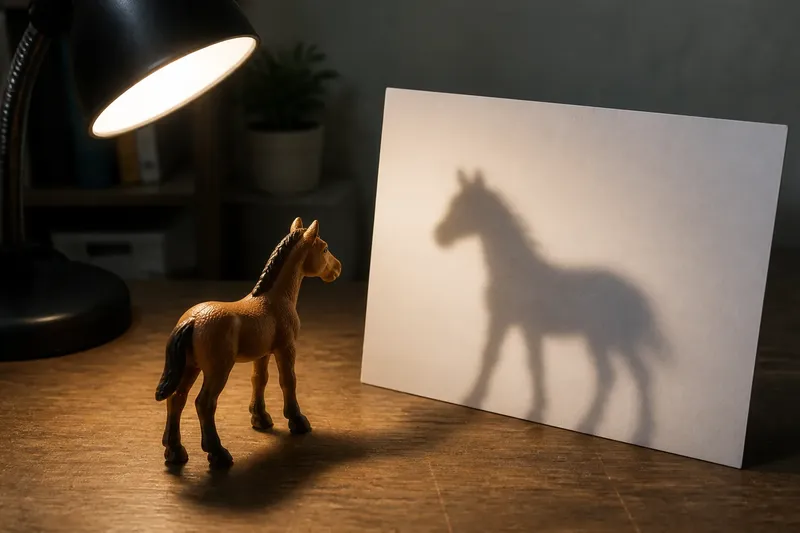
A shadow edge turns soft when part of the light source remains visible around the object. To understand shadow softness, look at the glowing area’s apparent size and the gap between the object and the receiving surface.
A compact lamp can make a crisp-looking boundary, while a broad window or nearby lantern can produce a gradual transition. The edge is a clue to how light reaches the surface, not a line the object has drawn.
Where the light goes
Light comes from different parts of an extended source. Near a shadow’s boundary, the object blocks some of those directions but leaves others open. The surface there receives only part of the source’s light, so illumination fades across a band.
The darkest region, where the source is fully blocked, is the umbra. The partly lit band around it is the penumbra. In ordinary viewing, neither has to appear as a perfectly defined shape: surface texture, contrast and reflected light affect how the boundary looks.
Think of the source as the area that glows, not the lamp’s centre. A bulb may be small, but a diffuser, illuminated shade or visible filament can change the apparent emitting area.
Source size and distance
A compact-looking source tends to make a narrow penumbra. A broad source, or one close enough to appear large from the object, tends to make a wider transition. The important feature is the source’s apparent size as seen from the object.
The object-to-surface gap matters too. When an object sits close to a wall or card, rays from different parts of the source have less room to spread before reaching the surface. The transition is usually narrower than when the object is held farther away.
These effects work together. A broad source with a large object-to-surface gap often gives a soft edge; a compact-looking source and a small gap tend to give a crisper one. The object’s shape still affects the outline, so do not mistake a curved contour for source softness.
Read the boundary
Check the transition band, not only the darkest part of the shadow. A glossy table can show bright reflections that confuse the boundary, while a textured wall can break it into distracting patches. Matte white card makes the transition easier to inspect.
Room light and reflected light also affect perceived contrast. A shadow may look lighter on one side because a nearby wall or pale surface reflects light into it. That does not necessarily mean the direct-light edge has moved.
It is not worth trying to remove every trace of reflected light from an ordinary room. For a useful explanation, a visible difference between a narrow and broad transition is enough.
Shadow edge questions?
Does moving a lamp soften a shadow edge?
It can. A nearby lamp generally appears larger to the object than the same lamp farther away, which can broaden the penumbra. The result also depends on where the object and receiving surface sit.
Why does a window make soft shadows?
A bright window presents a broad area from which light reaches the object along many directions. Near the boundary, the object blocks some of those directions but not all, creating a gradual transition.
Can a small lamp make a soft edge?
Yes. It may appear large if placed close to the object, or the object may be far from the receiving surface. A shade or diffuser can also make the glowing area larger than the bulb itself.
Why is one side of a shadow softer?
The source may be partly obscured or unevenly illuminated, and the object’s contours can change which rays reach each part of the edge. Reflected light can also alter contrast unevenly, making one side appear softer.
A worked comparison
Say you have a toy, a desk lamp and a sheet of plain card. In this invented situation, the toy begins midway between the lamp and card, with the lamp and card fixed. First, note the width and appearance of the transition at the toy’s shadow edge. Next, move the toy close to the card without turning it; the expected result is a narrower transition. Move it back to its starting place, then move it closer to the lamp; because the lamp now appears larger to the toy, the edge may broaden. The comparison distinguishes the effect of the toy-to-card gap from the apparent size of the source, though changing lamp position also changes the geometry of the whole arrangement.
Choose the next adjustment
Use these observations to decide what to change. Keep the toy’s orientation steady so a different contour does not confuse the comparison.
- Observe whether the glowing area is compact or broad; if it looks compact and you want a softer edge, move the lamp closer, otherwise leave its position alone.
- Observe whether the object nearly touches the card; if it does and you want a softer edge, increase the gap, otherwise keep the gap steady.
- Observe whether the shadow has a clear dark centre; if it does not, bring the object nearer to the card or use a more compact-looking source, otherwise retain the arrangement.
- Observe whether reflections create bright patches on the receiving surface; if they do, switch to matte white card, otherwise keep the surface.
- Observe whether the object’s outline changes as it moves; if it does, hold its orientation fixed and repeat the comparison, otherwise continue with the current position.
- Observe whether the transition is difficult to distinguish from surrounding room light; if it is, dim nearby lights where safe and practical, otherwise leave the room lighting unchanged.
What the edge tells you
For a crisp outline, use a compact-looking source and place the object near the receiving surface. For a softer boundary, choose a broad-looking source or increase the gap between object and surface. If the edge looks uneven, inspect the glowing area, the object’s contours and reflected light before blaming the lamp alone.
For shadow-edge softness, the useful question is which parts of the source can reach each part of the surface. Read the apparent source size and the object-to-surface gap together; the boundary then becomes a practical clue to the paths of light.